



⁂ 与李承宽相切:那座并不在那⼉的房⼦
Tangent 05: The House That Was Not There
- 01
- 07
- 2026
⽇记:2025 年 12 ⽉ 27 ⽇
提契诺州索尔杜诺市,葡萄园路 61B 号,邮编 CH-6600,2025 年 12 ⽉ 21 ⽇。今晚值得被认真记录下来。并⾮因为发⽣了什么戏剧性的事件,⽽是因为此刻的星位精准得近乎布置好的舞台,仿佛是这个房间本身决定开始思考。
我们五个⼈站在书房⾥。没有⼈坐下。这⼀点本身就说明了什么。书架环绕四周,空⽓中是熟悉的纸张、灰尘与⽊头的⽓味,窗户清洁剂残留的⼀丝柑橘味尚未散去。窗外,索尔杜诺的坡地逐渐沉⼊⿊暗;室内的灯光温暖⽽克制。这个房间仿佛从世界中悬置了出来。
我们是朋友,却有着分岔的⽣命履历。有时,正是这些分岔带来意想不到的发现。
⼀⼈出⽣于韩国,是美国⼈;⼀⼈出⽣于美国,如今是瑞⼠⼈,已放弃美国国籍;⼀⼈是德国⼈,同时也是瑞⼠⼈;⼀⼈出⽣于德国,持有三本护照;⼀⼈是中国⼈;⼀⼈说德语时带着奥地利⼝⾳。我们共享的显然并⾮共同的出身,⽽是⼀个由不同轨迹勾勒的当下。
我们站⽴在这些差异之中。某个时刻起,这种混搭不再显得异乎寻常,⽽成为了某种思考得以发⽣的起点。
我们没有在看书。
我们在看那张海报。
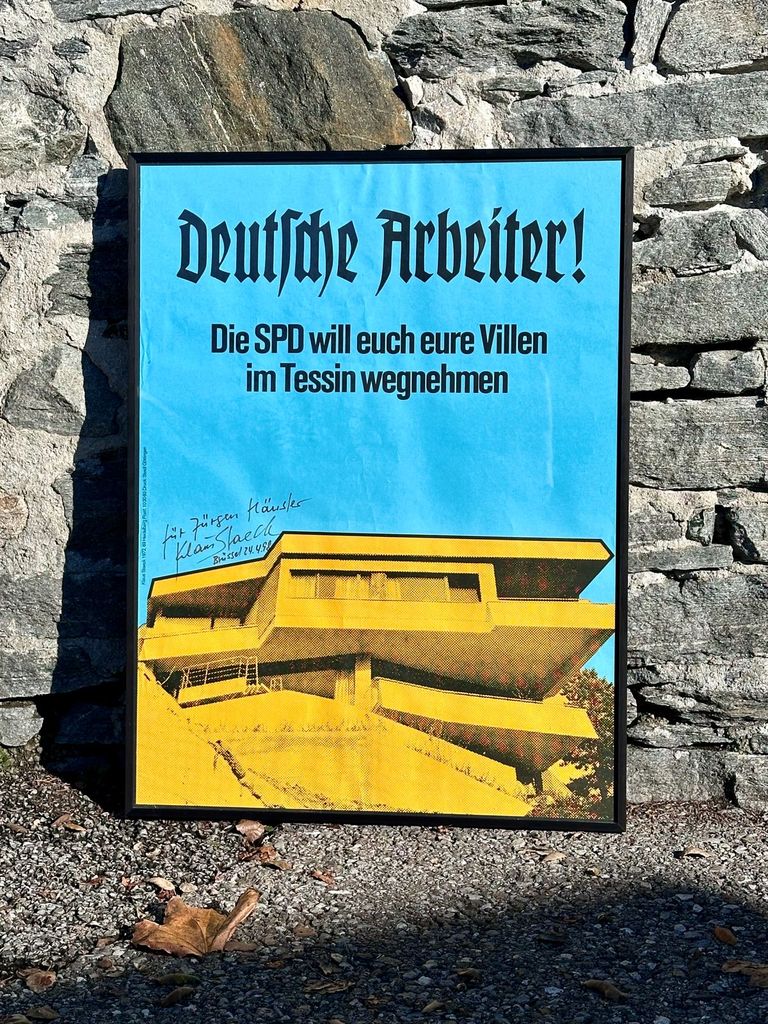
它略微脱离书架悬挂着,装裱极其简单,没有装饰,仿佛坚持⾃⼰并⾮装饰意义上的艺术品。纸张已经⽼化,颜⾊黯淡却仍然完整。作者──克劳斯·施泰克(Klaus Staeck)。
其⽂字的严酷感来⾃⼀种极端的简化:
Deutsche Arbeiter!
Die SPD will euch eure Villen im Tessin wegnehmen.
“德国⼯⼈!
社⺠党要夺⾛你们在提契诺的别墅。”
这句话我们曾反复阅读⽆数次,今晚,它显得格外响亮。
这张海报⼏乎在任何理解发⽣之前就已经⽣效。称呼对象──“德国⼯⼈”──召唤出⼀个被想象为朴素、勤勉、⾃律的集体。接着是失去之物:提契诺的别墅。阳光、南⽅、休闲、特权。最后是威胁的施加者:社会⺠主党,正是那个历史上主张代表这些⼯⼈的政党。整句话的结构,像是⼀条被剥去所有修辞的政治谎⾔。
我们笑了──就像所有⼈最初都会笑的那样。笑声很短。
施泰克的海报从来不是笑话。它们是陷阱。它们邀请笑意,只是为了揭露笑意所掩盖的东⻄。克劳斯·施泰克⽣于 1938 年,受训为律师,⾃ 1960 年代末起将平⾯设计作为政治⼲预的⼿段。他的海报廉价、可复制、刻意挑衅。在那个特定的历史时刻,它们占据街道、⽕⻋站与墙⾯。它们不作解释;它们进⾏指控。图像与⽂字相互碰撞,并⾮为了澄清,⽽是为了制造不稳定。
这张海报属于那个年代的⼀种以平⾯设计进⾏政治⼲预的实践。它⾸次制作于 1972 年,那正是 1970 年代初⻄德政治被恐惧修辞所吞噬的时刻。保守派不断发出警告:社会主义、征⽤和混乱即将来临。施泰克并不以反驳回应,⽽是选择夸张。如果恐惧本身是荒谬的,他就让这种荒谬显形。
挂在此处的版本由施泰克于 1998 年亲笔签名。那道红⾊的签名,将这⼀挑衅锚定在另⼀个时间点。数⼗年之后,当这张海报已不再在街头流通,⽽是作为⼀种记忆之物存续下来:依然锋利,依然可读。
然⽽──就在今晚──这张海报拒绝安于历史。
有⼈说道:“海报上这是哪⼀栋别墅?”
图像展示的是⼀座现代住宅:平屋顶、⽔平线条、⼤⾯积玻璃。房⼦看起来颇为昂贵,但并不巴洛克;没有柱⼦,也没有怀旧意味。是那种为阅读建筑杂志的⼈设计的别墅。
另⼀个⼈半开玩笑、半认真地问:“它在提契诺的哪⾥?”
这个问题停留得⽐预想的要久。
这栋房⼦在提契诺的哪⾥?
鉴于我们此刻就在索尔杜诺、正身处提契诺的⼀栋有着真实地址的真实房⼦⾥⾯,海报上关于地点的说法忽然成了⼀个绕不过去的问题。我们了解提契诺。我们也知道这⾥的别墅都是什么样⼦:湖畔的宫邸、理性主义的实验住宅、战后混凝⼟粗野主义、藏在树篱后的安静中产之家。可眼前这栋房⼦,并不真正属于其中任何⼀种。
答案在稍后才出现。⼀旦出现,它既简单,⼜不容回避:它根本不在提契诺。
这栋房⼦位于斯图加特。
不仅如此──它还有⼀位明确的作者。
施泰克海报中所描绘的建筑,实际位于斯图加特的埃杜瓦尔-法伊弗街 29 号。严格来说,它甚⾄不是⼀栋别墅,⽽是⼀栋多户住宅;施泰克在艺术处理上移除了其上层体量,以强化挑衅效果。其建筑师为李承宽。
这⼀事实改变了⼀切。
李承宽 1915 年出⽣于上海以⻄的吴兴,在不伦瑞克与柏林学习建筑,师从布鲁诺·陶特与汉斯·珀尔⻬希,并在战争期间及战后与汉斯·夏隆共事。他属于⼀个规模不⼤、却⽴场坚定的建筑师群体──他们发展并始终坚持“有机建筑”的理念:将建筑理解为由地景、运动与使⽤⽅式塑造的⽣命体,⽽⾮运作⾼效的机器。
这栋斯图加特的住宅正属于这⼀思想与建筑谱系。它建成于战后数⼗年间,正值斯图加特在物质与象征层⾯上进⾏⾃我重建之际。城市追求清晰、克制与专业性,拒绝过度,拒绝奇观。建筑被视为应当承担责任。
这⼀伦理在此得到了精准的体现。它并不强加于场地,⽽是顺应地形;空间回应景观;房间并⾮以宣⾔式的⽅式出现,⽽是作为连续展开的序列。阳台、露台与窗户朝向光线与绿意。直⻆让位于被⽣活过的运动轨迹。这栋房⼦更像⼀种环境,⽽⾮⼀个物件。
在李承宽看来,居住是⼀种互动过程,需要在开放与退隐、接近与距离之间取得平衡。他拒绝将住宅视为“居住机器”,⽽坚持将其理解为⼀种有机体,认为住宅应该回应环境,适应需求,以⼈的尺度为核⼼。这些原则不仅体现在独栋住宅中,也体现在他的⼤型住宅项⽬⾥:从斯图加特到柏林的 Märkisches Viertel,他建造了成千上万套住宅,均由类似的理念所塑形。
这不是⼀栋供消遣的别墅。
它是⼀座承载⽣活复杂性的建筑。
⽽这⼀差异⾄关要。
换⾔之──换“⾔”(word)即是换“世界”(world)──是语⾔在此发挥了作⽤。⼀栋位于斯图加特的多户住宅,被转化为“⼀栋提契诺的别墅”;随之,地点、历史与社会意义悄然错位。接下来发⽣的是⼀次刻意的错置:斯图加特被替换为瑞⼠;战后有机现代主义被转译为地中海式的特权想象;⼀座经过精细构造的住宅建筑,被简化为继承性中产奢华的象征。
这个谎⾔是精确的。
它揭示了政治恐惧的运作⽅式。恐惧并不需要准确性,它需要的是能够引发情感共振的图像。在这⾥,提契诺充当了⼀种速记符号:阳光、财富、逃离。⾄于这栋房⼦从未位于那⾥这⼀事实,对该运作机制⽽⾔并不重要。
随后才逐渐显现的,是由李承宽这⼀作者身份引⼊的额外反讽。⼝号向“德国⼯⼈”发声,警告他们即将失去⼀栋房⼦;⽽这栋房⼦本身,恰恰是迁移、兑换与全球思想⽹络的产物──由⼀位受欧洲现代主义训练的中国建筑师设计,在德国建造,却在修辞中被移置到瑞⼠。
国族范畴⼀经审视即告崩解。
有⼈低声说:“这栋房⼦⽐海报所透露出来的要全球化得多。”
另⼀⼈补充:“也⽐那种威胁给⼈的感觉更有⼈情味。”
李承宽的建筑从来不是关于对占有的宣示,⽽是关于居住作为过程:身体如何移动、停顿、退隐与聚集。海报剥夺了这种智能,将其转化为焦虑的对象。
我们并不清楚施泰克是否与这栋建筑或其建筑师存在任何关系,也没有证据表明他具备特定的建筑兴趣或私⼈关联。重要的不是意图,⽽是效果。
这种缺席并⾮偶然。施泰克反复强调,他的海报并⾮论证,⽽是⼲预。它们在公共空间中运作,在分心、烦躁和情绪准备的状态下,一瞥即生效。在这⼀逻辑中,图像并⾮知识的场所,⽽是投射的媒介;它们被选择,不是因为其所包含的内容,⽽是因为其所触发的反应。去追问这栋房⼦是否被准确描绘、甚⾄是否被正确定位,本身就已经偏离了问题的核⼼。
因此,这座建筑在海报中被抽空了其建筑意义。不论是其空间逻辑、与景观的关系还是社会层⾯的雄⼼,对海报的运作⽽⾔都⽆关紧要。剩下的只是现代性的剪影:平屋顶、玻璃和⽔平线条⾜以标志有钱⼈,却不必提供任何具体细节。在这⾥,建筑被压缩为⼀种视觉刻板印象,⼀种可在地理与社会层⾯⾃由挪⽤⽽⼏乎不产⽣阻⼒的符号。
施泰克选择这⼀图像,并⾮因为其建筑细节,⽽是因为其即时可读性。⾄ 1970 年代初,现代建筑已作为⼀种视觉速记,指向教养、品味与社会区分。现代主义,这⼀曾被构想为激进且具有社会改⾰意图的项⽬,已开始转化为⼀种资产。然⽽,海报的效⼒并不能仅归结为图像本身。⽂字、字体与⾊彩构成了⼀个整合的装置。全⼤写的称呼“Deutsche Arbeiter!”在反思发⽣之前便完成了对集体主体的召唤。紧随其后的句⼦在句法上⾼度节制、在节奏上刻意突⺎、在逻辑上故意不可信。蓝⾊的天空与⻩⾊的房⼦──通常与乐观的态度、⼀⽬了然的视觉效果及中产阶级的安定感相关的颜⾊──并未削弱信息,反⽽通过对⽐强化了其批判锋芒。最终呈现的不是对沉思的邀约,⽽是⼀套经过校准的即时识别机制。施泰克的海报不负责解释,它只负责激活。
海报所上演的并⾮恐惧本身,⽽是制造恐惧的技术。它执⾏的是⼀种基于夸张、错置与情感捷径的政治策略。通过将威胁的逻辑推向荒谬的边缘,施泰克使这⼀机制本身变得可⻅。海报并不为某⼀⽴场辩护;它展示⽴场是如何被⽣产出来的。图像、⽂字与设计并不相互阐释,⽽是同步运作。建筑在此不再作为空间或居住⽽被理解,⽽是作为⼀种可转移的符号,嵌⼊警报式修辞之中。恐惧不是信息;它是被展示的⽅法。
站在这⾥的,是五个⽣命轨迹恰由⼀种这张海报所试图抹去的全球化纠缠所塑造的⼈。正因如此,我们并未将这张海报体验为已然封闭的历史对象。它从来就不只是对“德国⼯⼈”说话。从⼀开始,它便设置了⼀种⾃称代⾔他们的发声⽅式,同时也暴露出廉价政治论战与恐惧⽣产的运作机制。被呈现出来的,并不是某种⽴场,⽽是⼀条修辞捷径:将复杂性压缩为威胁,把社会不安转译为指控。
从这个意义上说,海报转向了外部。它指向那些识别其编码的⼈。它的⼒量不在于说服,⽽在于揭露。它不论证;它展示图像与⼝号是如何被轻易动员来对抗思考本身的。它所要求的不是认同,⽽是识别。
这样⼀来,⼀个看似事实性的问题的功能变了。“这栋别墅在提契诺的哪⾥?”这个问题不再寻求核实或纠正,⽽成为对再现如何置换现实、以及这种置换如何被轻易接受的探针。问题随之再次转向:究竟是谁,通过遮蔽事物的真实所在⽽获益?
焦点从错误转向利益。⼀旦房⼦的错位被识别,问题便不再是事实纠正,⽽是政治功能。海报正是通过将图像从其真实地点、历史与社会语境中剥离⽽运作的。斯图加特变成提契诺,多户住宅变成别墅,建筑变成特权。这种错置不是信息的缺陷,⽽是其成⽴条件。只要地点可以互换、意义可以漂浮,海报就能⽣效。
因此,不知道事物真实所在并⾮⼀种中性的⽆知状态,⽽是⼀种⽣产性的状态。它允许恐惧⽆阻地流通,让怨恨附着于图像⽽⾮现实,让政治主张⽆需核查即可运作。受益者不是被误导者,⽽是那些通过简化进⾏动员的⼈──那些依赖空间、社会与象征混乱,将复杂关系转化为情绪上可识别威胁的⼈。
室外,提契诺的⼭丘保持沉默。室内,斯图加特悬挂在墙上,被误名,却不可误认。海报完成了优秀政治艺术始终要做的事情:它拒绝安慰。它要求我们不仅思考政治,也思考建筑作为其共谋者──及其⻅证者。
我们在此书写,是为了记录当政治图像既不被相信、也不被拒绝,⽽是被持续、从容地注视时,会发⽣什么。⼀张海报、⼀栋房⼦、五段⽣命,通过对话进⼊关系之中。机制并未消失,但变得可读。真正打断其⼒量的,不是愤慨,⽽是将事物──地点、房屋、词语──重新安置回它们被⽤来简化的那个世界中的集体劳作。
谈话松动之后,有⼈⾛向钢琴。没有过渡的感觉,也⽆需为这⼀刻定调。肖邦 C ⼤调练习曲作品 10 第 1 号的⼏⼩节在房间中响起,安静⽽克制。⾳乐并未回应讨论,也未解决它。它以另⼀种⽅式延续同⼀姿态:放慢感知,在不要求结论的情况下承载复杂性。
我们静静聆听。海报仍在墙上;斯图加特的房⼦仍在原地。没有事物被纠正,也没有结论被总结。但节奏已经改变。政治图像所依赖的那些紧迫性、即时性和情绪失去了抓⼒。剩下的是共享的在场:⼀种注意⼒的形式,使好奇、投⼊与对话得以浮现,并⾮通过论证,⽽是通过与图像停留得⾜够久,让问题⾃⾏开启。
夜晚在餐桌旁继续,来⾃不同地⽅的酒随意打开。谈话慢慢展开,⼜慢慢松散下来。有关故⼟、迁移和习惯的故事偶尔浮现,却没有⽤来证明什么。差异没有消失,也没有被强调,它们只是待在那⾥。那张海报仍在视野之中,却不再占据中⼼。思考并未中断,但也不再以批判的姿态出现,⽽是作为⼀种关系被维持着。直到这时,夜晚才真正接近尾声。
注
“提契诺的别墅”仍作为⼀种⽂化形象存续。它曾在展览“Villa im Tessin”中重现,该展览于 2018 年 8 ⽉ 1 ⽇⾄ 10 ⽉ 7 ⽇在斯图加特的魏森霍夫建筑画廊展出,追溯这⼀建筑⺟题如何从 1970 年代初的政治图像迁移⾄⽇常⽂化之中。与此同时,“提契诺的别墅”也以物质形式延续──作为 Faller 公司⽣产的塑料模型套件。该模型为 HO ⽐例(1:87),由注塑塑料部件构成,具有平屋顶、外挑体量与⼤⾯积窗⾯,最早于 1961 年推出,⾃ 1960 年代初起售出约 40 万套,初始售价约为 5 德国⻢克(视版本⽽定)。在 Faller 的⽬录中,该模型被介绍为“经典之作”,描述为:“⼀种典型的南⽅乡村住宅。最现代的建造⽅式。该模型的原型位于安布⾥(Ambrì),坐落在圣哥达-卢加诺公路旁。”
因此,除海报图像之外,该模型亦指向提契诺的⼀处真实存在的建筑原型 ── 安布⾥的 Giovanni Guscetti 别墅,由 Edwin & Hermann Faller 于 1960 年前后选中,作为模型形式的灵感来源。该建筑在 Faller 的产品⽂档中被列为现代主义经典之⼀,⾄今仍以复刻版形式出售,零售价约为 40–50 欧元。在这种可复制的微缩形态中,“提契诺的别墅”作为⼀种介于建筑传播、游戏与⽂化记忆之间循环流通的图像-物件⽽持续存在。
The House That Was Not There
Diary Entry : December 27, 2025
Eric Häusler
Jürgen Häusler
Via alle Vigne 61B, CH-6600 Solduno, Ticino, December 21, 2025. This evening deserves to be written down carefully. Not because something dramatic happens, but because the constellation is exact, almost staged, as if the room itself decides to think.
Five of us stand in the library. No one sits down. That already says something. Bookshelves line all sides, the familiar smell of paper, dust, wood, a trace of citrus from the window cleaner lingering in the air. Outside, the slope of Solduno fades into darkness; inside, the light is warm and contained. The room feels suspended from the world.
We are friends whose biographies diverge. At times, this leads to surprising discoveries.
One is born in South Korea and is American. One is born in the United States and is now Swiss, having renounced U.S. citizenship. One is German and also Swiss. One is born in Germany and holds three passports. One is Chinese. One speaks German with an Austrian accent. What we share is not a common origin, but a present shaped by different trajectories.
We stand among them. At some point, this mixture stops feeling remarkable. It becomes the ground on which our thinking happens.
We are not looking at the books.
We are looking at the poster.
It hangs slightly apart from the shelves, framed simply, without ornament, as if insisting that it is not art in the decorative sense. The paper is aged. The colors are muted but intact. The author: Klaus Staeck.
The text is brutal in its simplicity:
Deutsche Arbeiter!
Die SPD will euch eure Villen im Tessin wegnehmen.
German workers!
The SPD wants to take away your villas in Ticino.
We read this sentence countless times. Tonight, it sounds louder.
The poster works instantly, even before understanding begins. The address – German workers – summons a collective imagined as modest, productive, disciplined. Then comes the object of loss: villas in Ticino. Sun, south, leisure, privilege. And finally the agent of threat: the Social Democrats, historically the party that claims to represent those very workers. The sentence is structured like a political lie stripped to its bones.
We laugh, as everyone does at first. The laughter is short.
Staeck’s posters are never jokes. They are traps. They invite amusement only to expose what amusement conceals. Born in 1938 and trained as a lawyer, Klaus Staeck uses graphic design as political intervention from the late 1960s onward. His posters are cheap, reproducible, and deliberately confrontational. At that historical moment, they occupy streets, train stations, and walls. They do not explain; they accuse. Image and text collide, not to clarify, but to destabilize.
This poster belongs to that practice of political graphic intervention. It is first produced in 1972, in the climate of the early 1970s, when West German politics is saturated with fear rhetoric. Conservatives warn of socialism, expropriation, chaos. Staeck responds not with counterarguments, but with exaggeration. If fear is absurd, he makes it visible.
The copy that hangs here is hand-signed by Staeck in 1998. The red signature anchors the provocation in another moment, decades later, when the poster no longer circulates in the streets but survives as an object of memory — still sharp, still legible.
And yet – tonight – the poster refuses to remain safely historical.
Someone says, “Which villa is that supposed to be?”
The image shows a modern house: flat roof, horizontal lines, generous glazing. It looks expensive, but not baroque. No columns, no nostalgia. A villa for people who read architecture magazines.
Someone else says, half joking, half serious, “Where in Ticino is that?”
The question lingers longer than expected.
Where is this house in Ticino?
As we stand here in Solduno – in an actual house in Ticino, with an actual address – the poster’s geographic claim suddenly demands inspection. We know Ticino. We know its villas: lakeside palazzi, rationalist experiments, postwar concrete brutalism, quiet bourgeois houses hidden behind hedges. This house does not quite belong.
The answer arrives later. When it does, it is simple and decisive.
It is not in Ticino at all.
The house stands in Stuttgart.
And not only that – it has an author.
The building depicted in Staeck’s poster stands at Eduard-Pfeiffer-Straße 29 in Stuttgart. It is not even a villa in the strict sense, but a multi-family house whose upper storey Staeck removes in artistic license to sharpen the provocation. The architect is Chen Kuen Lee.
This fact changes everything.
Chen Kuen Lee is born in 1915 in Wuxing, west of Shanghai. He studies architecture in Braunschweig and Berlin, learning from figures such as Bruno Taut and Hans Poelzig, and later works with Hans Scharoun during and after the war. He belongs to a small circle of architects who develop and remain faithful to the idea of organic architecture – an approach that understands buildings not as machines, but as living organisms shaped by landscape, movement, and use.
The Stuttgart house belongs to this intellectual and architectural lineage. It is built in the postwar decades, when Stuttgart reconstructs itself materially and symbolically. The city seeks clarity, sobriety, competence. No excess, no spectacle. Architecture is expected to be responsible.
The house reflects this ethos precisely. It does not impose itself on the site; it follows the terrain. Space responds to landscape. Rooms unfold as sequences rather than statements. Balconies, terraces, and windows open toward light and greenery. Right angles yield to lived movement. The house behaves less like an object than like an environment.
Chen Kuen Lee understands housing as an interactive process, balancing openness and retreat, proximity and distance. He rejects the idea of the house as a “living machine” and insists instead on the house as an organism – responsive, adaptive, human-scaled. These principles appear not only in single-family homes, but also in his large housing projects, from Stuttgart to Berlin’s Märkisches Viertel, where he builds thousands of buildings shaped by similar ideas.
This is not a villa of leisure.
It is a building of lived complexity.
And that distinction matters.
In other wor(l)ds, language does the work. A Stuttgart multi-family house becomes a “villa in Ticino,” and with it, place, history, and social meaning slide quietly out of alignment. What follows is a deliberate act of misplacement: Stuttgart turns into Switzerland; organic postwar modernism into Mediterranean privilege; a carefully articulated residential building into a symbol of inherited bourgeois luxury.
The lie is precise.
It reveals how political fear operates. Fear does not need accuracy. It needs images that resonate emotionally. Ticino functions here as shorthand: sun, wealth, escape. The fact that the house never stood there is irrelevant to the mechanism.
What becomes clear only later is the additional irony introduced by Chen Kuen Lee’s authorship. The slogan addresses German workers, warning them about the loss of a house that is already the product of migration, exchange, and global intellectual networks: designed by a Chinese architect shaped by European modernism, built in Germany, and rhetorically relocated to Switzerland.
National categories collapse under inspection.
One of us says quietly, “This house is more global than the poster admits.”
Another adds, “And more humane than the fear suggests.”
Chen Kuen Lee’s architecture is never about ownership as display. It is about inhabitation as process. About how bodies move, pause, retreat, and gather. The poster strips the building of this intelligence and turns it into an object of anxiety.
It is not known what relationship, if any, Staeck has to the building or to its architect. There is no evidence of a specific architectural interest or personal connection. What matters is not intention, but effect.
This absence is not accidental. Staeck repeatedly insists that his posters are not arguments, but interventions. They are designed to function in public space at a glance, under conditions of distraction, irritation, and emotional readiness. Images, in this logic, are not sites of knowledge but of projection. They are chosen not for what they contain, but for what they trigger. To ask whether the house is accurately represented, or even correctly located, is already to miss the point.
The building therefore appears emptied of its architectural intelligence. Its spatial logic, its relationship to landscape, its social ambition are irrelevant to the poster’s operation. What remains is a silhouette of modernity – flat roof, glass, horizontality – enough to signal affluence without specificity. Architecture here is reduced to a visual stereotype, a transferable sign that can be displaced geographically and socially without resistance.
Staeck does not select the image for architectural nuance, but for its immediate legibility. By the early 1970s, modern architecture already operates as a visual shorthand for cultivated taste and social distinction. Modernism, once conceived as a radical and socially reformist project, has entered its conversion into an asset. The poster’s efficacy, however, cannot be reduced to the image alone. Text, typography, and chromatic register function as an integrated dispositif. The block-capital address, Deutsche Arbeiter!, interpellates a collective subject prior to reflection. The sentence that follows is syntactically economical, rhythmically abrupt, and deliberately implausible. The blue sky and yellow house – colors conventionally associated with optimism, clarity, and bourgeois reassurance – do not soften the message but sharpen its critical edge through contrast. What emerges is not an invitation to contemplation, but a calibrated mechanism of instant recognition. The poster does not explain; it activates.
What the poster stages is not fear itself, but the technique of producing fear. It performs a political strategy based on exaggeration, displacement, and emotional shortcutting. By pushing the logic of threat to the edge of absurdity, Staeck makes the mechanism visible. The poster does not argue for a position; it demonstrates how positions are manufactured. Image, text, and design do not explain one another – they synchronize. Architecture becomes legible not as space or inhabitation, but as a transferable symbol within a rhetoric of alarm. Fear is not the message. It is the method placed on display.
Standing here, five people whose lives are shaped by the very global entanglements erased by the slogan, we do not experience the poster as historically closed. It never spoke to Deutsche Arbeiter alone. From the outset, it staged a form of address that claims to speak in their name, while exposing the mechanisms of cheap political polemic and fear production. What is put on display is not a position, but a rhetorical shortcut: the reduction of complexity to threat, the conversion of social unease into accusation.
In this sense, the poster turns outward. It addresses those who recognize the codes. Its force lies not in persuasion, but in exposure. The poster does not argue; it demonstrates how easily images and slogans can be mobilized against thought itself. Recognition, rather than agreement, is its demand.
From this position, a seemingly factual question changes its function. Where is this villa in Ticino? no longer seeks verification or correction. It becomes a probe into how representation displaces reality – and how readily that displacement is accepted. The question thus shifts again: Who benefits from not knowing where things actually are?
This question shifts the focus from error to interest. Once the house is recognized as mislocated, the issue is no longer one of factual correction, but of political function. The poster operates precisely by detaching images from their actual places, histories, and social contexts. Stuttgart becomes Ticino, a multi-family house becomes a villa, architecture becomes privilege. This displacement is not a flaw in the message; it is its condition. The poster works only as long as locations remain interchangeable and meanings unanchored.
Not knowing where things actually are is therefore not a neutral absence of information, but a productive state. It allows fear to circulate without resistance, resentment to attach itself to images rather than realities, and political claims to operate without verification. Those who benefit are not the misled, but those who mobilize by simplification – who rely on spatial, social, and symbolic confusion to transform complex relations into emotionally legible threats.
Outside, the hills of Ticino remain silent. Inside, Stuttgart hovers on the wall – misnamed but unmistakable. The poster does what good political art always does: it refuses comfort. It demands that we think not only about politics, but about architecture as its accomplice – and its witness.
We write this now to register what becomes possible when political images are met neither with belief nor with rejection, but with sustained, unhurried attention. A poster, a house, and five biographies enter into relation through conversation. The mechanism does not disappear, but it becomes legible. What interrupts its force is not indignation, but the collective work of situating things – places, buildings, words – back into the world they were meant to simplify.
After the conversation loosens, someone moves to the piano. There is no sense of transition, no need to frame the moment. A few bars of Chopin’s Étude No. 1 in C major, Op. 10 sound into the room – quiet and measured. The music does not respond to the discussion, and it does not resolve it. It continues the same gesture by other means: slowing perception, holding complexity without demand.
We listen without speaking. The poster remains on the wall; the house in Stuttgart remains where it is. Nothing is corrected, nothing concluded. But the tempo has shifted. What political images rely on – urgency, immediacy, affect – loses its grip. What remains is shared presence: a form of attention that allows curiosity, engagement, and dialogue to emerge, sustained not through argument, but by staying with the image long enough for questions to open.
The evening continues at a table with wine from different places, opened without ceremony. The conversation resumes – slower now, less directed. Stories of origin, movement, and habit surface without being claimed as evidence. Differences are neither erased nor sharpened; they coexist. The poster does not disappear from view, but it no longer dominates it. Thinking persists, not as critique performed, but as relation maintained. Only then does the evening draw to a close.
Footnote
The “Villa in Ticino” continues to live on – as a cultural figure. It reappeared in the exhibition “ Villa im Tessin ” , shown from 1 August to 7 October 2018 at the Architekturgalerie am Weißenhof, which traced how an architectural motif migrated from the political imagery of the early 1970s into everyday culture. At the same time, the “Villa in Ticino” persists materially as a mass-produced plastic model kit by the company Faller: the model (H0 scale, 1:87) consists of injection-moulded plastic parts with a flat roof, projecting volumes, and large window surfaces; it was first released in 1961, sold from the early 1960s onward in around 400,000 copies, and originally priced at approximately 5 Deutsche Mark, depending on the version. In Faller’s own catalogues, the kit is introduced as a Klassiker, described as “ Ein typisches Landhaus aus dem Süden. Modernste Bauweise. Das Vorbild dieses Modells steht in Ambrì an der Straße Gotthard–Lugano.” Beyond the poster image, the kit thus refers to a real architectural precedent in Ticino, the Villa Giovanni Guscetti in Ambrì, discovered by Edwin and Hermann Faller around 1960 and used as the formal inspiration for the model. Listed accordingly in Faller’s product documentation as part of the company’s canon of modernist classics, the Villa im Tessin is still available today as a reissued classic with a contemporary retail price in the range of €40–50. In this serial miniature form, the “Villa in Ticino” endures as a circulating image-object situated between architectural mediation, play, and cultural memory.
- 参考文献:
- Dietrich Heißenbüttel, “Villa im Tessin für alle. Faller-Häuser groß und klein, ”StuttgarterZeitung, 1 August 2018.
- Falk Jaeger, “Architektur von Chen Kuen Lee – Das Haus als Organismus, ”Stuttgarter Nachrichten, 8 December 2015.
- Il sogno americano. Architettura nelle Alpi negli anni ’50, Ausst.-Kat. Casa Cavalier Pellanda, Biasca 2017.
- https://weissenhofgalerie.de/rueckblick#2018.
- https://www.fnp.de/deutschland/eine-villa-tessin-10392662.html.
- https://www.hochparterre.ch/nachrichten/kultur/das-dritte-leben-der-villa-guscetti.
- https://www.guscetti.ch/architettura/progetti/casa-ad-ambri.html.
- https://www.faller.de/miniaturwelten/aus-der-reihe/klassiker/17490/b-271-villa-im-tessin?number=109271.
- https://dam-online.de/veranstaltung/maerklin-moderne/.


https://pictures.abebooks.com/isbn/9783468102004-uk.jpg
https://upload.wikimedia.org/wikipedia/commons/b/b5/Langenscheidt_logo.png
https://rolandhalbe.eu/wp-content/uploads/RH2356-0016.jpg
https://www.reimer-mann-verlag.de/controller.php?cmd=detail